
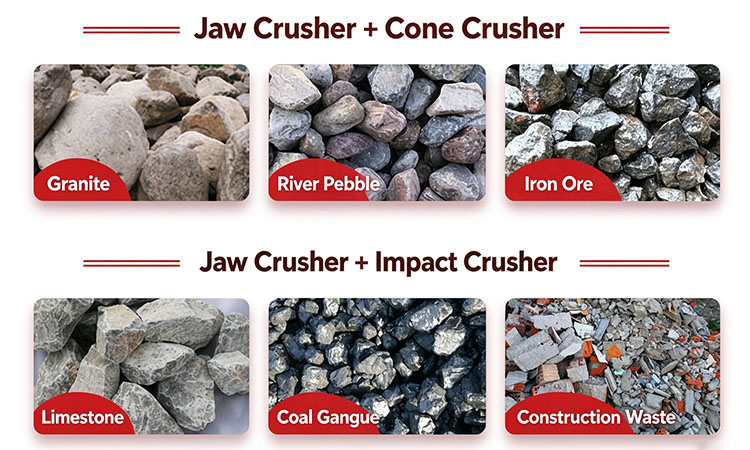
When building a stone crushing plant, many investors face an important question: Should you choose a jaw crusher + cone crusher or a jaw crusher + impact crusher? Both are common crushing plant configurations. A jaw crusher is usually used for primary crushing, but the choice of secondary crushing equipment can greatly affect material adaptability, final product quality, equipment investment, and operating costs. Choosing the right combination can help you improve production efficiency and avoid unnecessary expenses.

Basic Introduction to the Two Crushing Plant Configurations
1. Jaw Crusher + Cone Crusher
In this configuration, the jaw crusher performs primary crushing, while the cone crusher handles secondary or fine crushing.
A cone crusher uses the principle of compression crushing. The material is crushed between the mantle and concave through continuous pressure.
This combination is widely used in large-scale stone crushing and mining projects because of its strong crushing capacity and suitability for hard, abrasive materials.
Main Features:
– Suitable for hard and abrasive rocks.
– Good continuous production performance.
– Long service life of wear parts in suitable applications.
– Suitable for large-capacity crushing plants.
2. Jaw Crusher + Impact Crusher
In this configuration, the jaw crusher is responsible for primary crushing, and the impact crusher performs secondary crushing.
An impact crusher uses high-speed impact force to break materials. Stones are repeatedly impacted between the blow bars and impact plates until they reach the required size.
This combination is commonly used in limestone quarries, building material production, and construction waste recycling.
Main Features:
– Suitable for soft and medium-hard materials.
– Produces well-shaped cubic aggregates.
– Offers good shaping performance.
– Can be a cost-effective choice for suitable materials.

Five Main Differences Between the Two Crushing Lines
1. Different Material Adaptability
Jaw Crusher + Cone Crusher
– Granite
– Basalt
– River pebbles
– Iron ore
Cone crushers can handle high-strength and abrasive rocks with relatively good wear resistance.
Jaw Crusher + Impact Crusher
This combination is more suitable for soft and medium-hard materials, such as:
– Limestone
– Coal gangue
– Construction waste
– Concrete blocks
2. Different Final Product Shapes
Jaw Crusher + Cone Crusher
Cone crushers produce relatively uniform aggregate particles. The final particle shape depends on the equipment type, crushing chamber, feeding conditions, and operating parameters.
Jaw Crusher + Impact Crusher
Impact crushers have good shaping performance and can produce more cubic aggregates with fewer flaky and elongated particles.
If your project has strict requirements for aggregate shape, an impact crusher may be a suitable choice for less abrasive materials.
3. Different Applications
Jaw Crusher + Cone Crusher
This combination is commonly used in:
– Large stone quarries
– Mining operations
– Granite and basalt crushing
– High-capacity aggregate production
– Road construction material production
Jaw Crusher + Impact Crusher
This combination is commonly used in:
– Limestone crushing plants
– Building material production
– Concrete recycling
– Construction waste processing
– Small and medium-sized aggregate plants
4. Different Equipment Investment and Operating Costs
Jaw Crusher + Cone Crusher
The initial equipment investment is generally higher. However, when processing hard and abrasive rocks, cone crushers usually offer longer wear part life and lower wear costs. This can help reduce long-term maintenance expenses.
Jaw Crusher + Impact Crusher
The initial investment can be lower for some equipment configurations. However, blow bars and impact plates may need more frequent replacement, especially when processing abrasive materials.
Therefore, you should consider not only the purchase price but also wear part costs, energy consumption, and maintenance expenses.
5. Different Working Environments and Maintenance Requirements
Jaw Crusher + Cone Crusher
Cone crushers generally have a more enclosed crushing chamber. Dust collection systems and proper noise control can help create a cleaner working environment.
Jaw Crusher + Impact Crusher
Impact crushers involve high-speed rotor operation. Regular inspection of blow bars, impact plates, rotor components, and fastening parts is necessary.

When Should You Choose a Jaw Crusher + Cone Crusher Line?
A jaw crusher + cone crusher production line is recommended in the following situations:
1. Your raw materials are mainly hard rocks such as granite, basalt, and river pebbles.
2. Your project requires high hourly production capacity and long-term continuous operation.
3. Your final products are mainly used for road base, railway construction, or general aggregate applications.
4. You have a sufficient initial investment budget and want to control long-term wear part costs.
5. Your production line needs to process highly abrasive materials.
When Should You Choose a Jaw Crusher + Impact Crusher Line?
A jaw crusher + impact crusher production line is a good choice in the following situations:
1. Your raw materials are mainly soft or medium-hard stones, such as limestone.
2. Your required production capacity is suitable for the selected impact crusher model.
3. You need cubic-shaped aggregates for concrete, building materials, or other construction applications.
4. Your project involves crushing and shaping concrete blocks or construction waste.
5. You want to reduce the initial equipment investment for a suitable crushing application.
Get Your Stone Crushing Plant Solution from Luoyang Dahua
Luoyang Dahua is a professional manufacturer of crushing and screening equipment, providing equipment and complete solutions for mining and aggregate production. Whether you need a jaw crusher + cone crusher line for hard rock or a jaw crusher + impact crusher line for limestone and construction waste, we can help you select suitable equipment according to your material, production capacity, and final product requirements.
