Concrete blocks, demolished concrete, and construction waste can be recycled into reusable aggregates. These materials can be used for road construction, building projects, and other applications. However, choosing the right crushing equipment is important. Should you use a mobile crusher or a stationary crushing plant for concrete block recycling? The best choice depends on your project size, working location, processing capacity, and budget.

1. What Is a Mobile Crusher for Concrete?
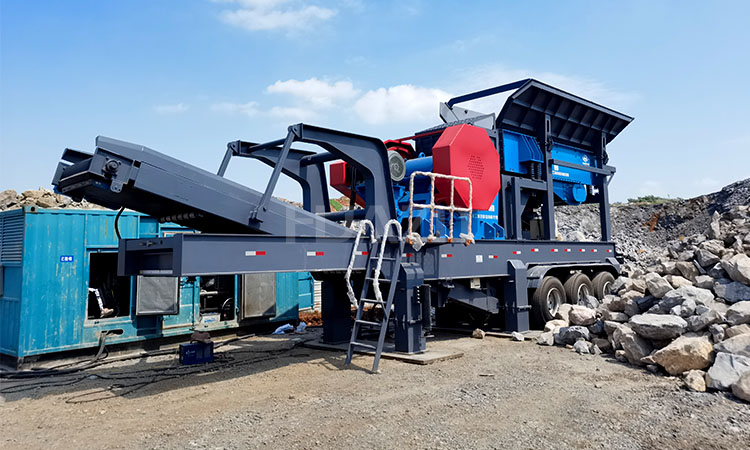
A mobile crushing plant integrates crushing equipment, a feeding system, and other necessary components on a mobile chassis or crawler-mounted platform. It can move between different working sites and process concrete blocks directly at the demolition or construction site.
Main advantages:
– Easy to move: Suitable for projects at different locations.
– Lower transportation costs: Concrete waste can be crushed near the demolition site, reducing the need to transport bulky waste.
– Quick installation: It generally requires less site preparation than a stationary plant.
– Flexible operation: Suitable for small and medium-sized concrete recycling projects, depending on the model.
A mobile jaw crusher is often used for primary crushing of large concrete blocks. If smaller aggregate sizes are required, a secondary crusher and screening equipment can be added to the process.

2. What Is a Stationary Crushing Plant for Concrete?
A stationary crushing plant is installed at a fixed location. It usually includes a feeder, jaw crusher, secondary crusher, vibrating screen, conveyor belts, and other equipment. It is suitable for concrete recycling businesses that process large quantities of material at one site over a long period.
Main advantages:
– Suitable for continuous production: A well-designed plant can handle a large volume of concrete waste.
– Flexible production configuration: Different crushers and screens can be selected according to the required aggregate sizes.
– Convenient process management: Fixed equipment layouts make it easier to organize material flow and production.
– Suitable for long-term projects: It is a good option for recycling plants with a stable supply of concrete waste.
However, a stationary plant usually requires more site preparation, installation work, and space. Moving the entire production line to another location is also more difficult.

3. Mobile Crusher vs. Stationary Crushing Plant
The following table compares the two solutions for concrete block recycling.
| Comparison | Mobile Crushing Plant | Stationary Crushing Plant |
| Working location | Multiple or changing sites | Fixed site |
| Installation | Generally faster | Requires more preparation |
| Site flexibility | High | Low |
| Production capacity | Depends on model and configuration | Suitable for a wide range of capacities |
| Transportation of concrete waste | Can reduce transportation needs | Waste may need to be transported to the plant |
| Initial investment | Depends on configuration | Depends on plant scale and infrastructure |
| Best application | Temporary projects and on-site recycling | Long-term, centralized recycling |
Which one is better? The actual investment and production capacity depend on the equipment model, material properties, required output size, and plant configuration. A mobile plant is not always cheaper, and a stationary plant is not always more productive.

4. What Equipment Is Needed for Concrete Block Recycling?
A typical concrete recycling process includes the following steps:
- Feeding: A feeder delivers concrete blocks into the crusher.
- Primary crushing: A jaw crusher reduces large concrete blocks into smaller pieces.
- Secondary crushing: An impact crusher or another suitable crusher further reduces the material when required.
- Screening: A vibrating screen separates the crushed material into different sizes.
- Iron removal: A magnetic separator can remove reinforcing steel and other magnetic metal pieces.
The exact equipment configuration depends on the size of the concrete blocks, the amount of reinforcing steel, the required aggregate size, and the target production capacity.
For reinforced concrete, removing steel and checking the feed material before crushing are particularly important. Suitable feeding, crushing, and screening equipment help improve the efficiency of the recycling process.

5. Choose the Right Concrete Recycling Equipment
Both mobile and stationary crushing plants can process concrete blocks. The right choice depends on your working conditions and production goals.
If you need flexible, on-site concrete recycling, a mobile crushing plant is worth considering. If you plan to operate a long-term recycling business with a stable material supply, a stationary crushing plant may be a better choice.
Luoyang Dahua provides crushing and screening equipment for different material processing applications. Our team can help you evaluate your concrete recycling requirements and select suitable equipment. Contact Luoyang Dahua to discuss your concrete crushing project.