
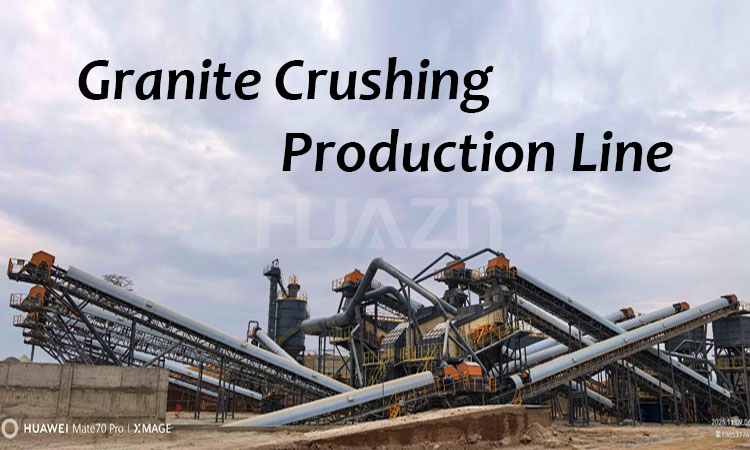
In mining, quarrying, and aggregate production, choosing the right crushing process is the key to improving production efficiency and reducing operating costs. For many types of rocks and ores, two-stage crushing is a common and effective solution.
But how should you choose the right equipment for a two-stage crushing plant? This article will introduce the basic process and recommended crusher combinations.

What Is Two-Stage Crushing?
Two-stage crushing means that the raw material is crushed twice by different types of crushers before entering the screening or grinding process. Usually, the process includes:
Primary Crushing → Secondary Crushing → Screening
The first stage reduces large rocks into smaller sizes, while the second stage further improves particle size and shape to meet the requirements of construction materials or industrial applications.
Compared with a single crusher, a two-stage crushing system can achieve higher crushing efficiency, better product particle size, and lower energy consumption.
It is widely used in quarries, mining operations, aggregate plants, and construction material production.

Common Two-Stage Crushing Equipment Combinations
The equipment selection depends mainly on:
- Raw material hardness
- Feed size
- Required output size
- Production capacity
- Final product requirements
Option 1: Jaw Crusher + Impact Crusher
Recommended for: Limestone, granite, basalt, and medium-hard rocks
This is one of the most popular two-stage crushing solutions.
The jaw crusher is used for primary crushing. It has a large feeding opening and strong crushing force, making it suitable for large-size raw materials.
The impact crusher is used for secondary crushing. It provides excellent particle shape and produces more cubic-shaped aggregates.
✔ High crushing efficiency
✔ Good final product shape
✔ Suitable for aggregate production
✔ Easy maintenance
This combination is widely used in road construction, concrete aggregate, and quarry projects.

Option 2: Jaw Crusher + Cone Crusher
Recommended for: Hard and abrasive materials
For hard rocks such as granite, basalt, and iron ore, cone crushers are often selected as secondary crushers.
The jaw crusher completes the first crushing stage, while the cone crusher provides high reduction ratio and excellent wear resistance.
✔ Suitable for high-hardness materials
✔ Longer wear part life
✔ Stable operation
✔ Lower maintenance cost for hard rock crushing
This solution is commonly used in large stone quarries and mining projects.

Option 3: Hammer Crusher + Screening
Recommended for: Medium-hard materials with simple requirements
For some limestone and similar materials, a hammer crusher can complete crushing in fewer steps.
However, for large capacity projects or materials with high abrasiveness, traditional two-stage crushing equipment is usually a better choice.
How to Choose the Right Two-Stage Crushing Plant?
Before selecting equipment, customers should consider the following factors:
1. Check the Raw Material Hardness
2. Consider the Required Capacity
3. Pay Attention to Final Product Requirements

Choose a Reliable Crushing Equipment Manufacturer
Selecting the right crusher is not only about equipment price. A professional crushing equipment manufacturer should provide:
- Complete crushing plant design
- Suitable crusher model selection
- Technical support
- Spare parts supply
- Installation and after-sales service
With years of experience in mining and aggregate equipment manufacturing, Luoyang Dahua provides customized crushing solutions for customers worldwide, including jaw crushers, impact crushers, cone crushers, vibrating screens, and complete crushing plants.
Whether you are processing limestone, granite, basalt, or mining ores, choosing the right two-stage crushing equipment can help improve production efficiency and maximize your investment value.