
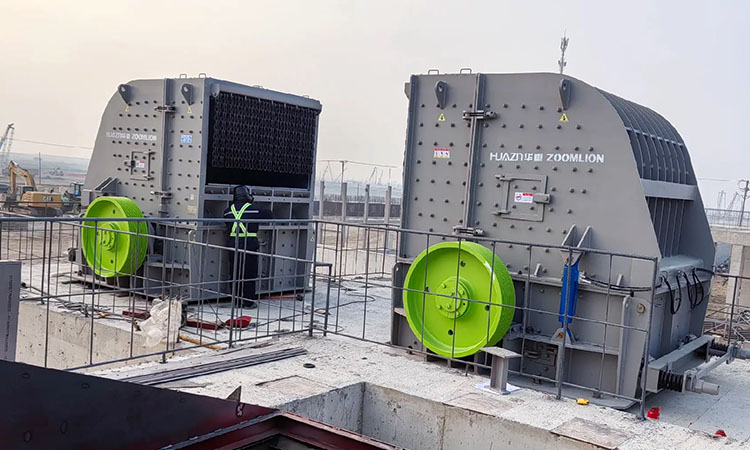
Impact crushers are widely used in mining, construction, and aggregate production for secondary or fine crushing applications. However, unqualified discharge particle size is a common problem in crushing circuits. This article analyzes the causes and provides systematic solutions.

Common Causes of Unqualified Coarse Discharge
4 primary factors lead to oversized discharge particle size:
Excessive clearance between impact plate and blow bar: This is the most direct cause. Under normal operation, the gap should be maintained at 15–20 mm for medium-hard materials. A gap exceeding 20 mm allows material to pass through without sufficient breakage. After 500 operation hours, wear can increase the clearance by 1–2 mm, necessating recalibration.
Worn blow bars: This is the second major cause. Blow bar wear diminishes impact energy transfer, resulting in incomplete fragmentation. Critical wear thresholds are >15 mm unilateral wear (loss of impact efficiency) and wear exceeding 20 mm (mandatory replacement required).
Inadequate rotor speed: Rotor speed directly influences discharge size through the residence time effect — lower speeds reduce impact energy and residence time, producing coarser material. Conversely, higher speeds enhance breakage. Speed adjustment is typically implemented via pulley replacement (changing drive ratios) or VFD installation for precise control.
Oversized or poorly graded feed material: Material exceeding the crusher’s nominal feed size may bypass crushing zones entirely. Severe feed size mismatch can also cause blockages.

Recommended Solutions
Once diagnosis is complete, the following solutions should be implemented:
Gap adjustment: Using adjustment bolts or hydraulic mechanisms, reduce the clearance between impact plate and blow bar to 15–20 mm. Ensure uniform clearance across the full width of the rotor. For fine crushing applications, gaps as small as 5–15 mm may be required.
Blow bar maintenance: For moderate wear, symmetrical blow bars can be turned (reversed) to expose unworn edges, extending service life by approximately 50%. When wear exceeds 20 mm, replace with high-chrome alloy blow bars (58–62 HRC) for improved wear resistance.
Rotor speed optimization: Adjust rotor speed based on material characteristics: limestone and other soft materials → 1000–1200 r/min; granite and hard materials → 1200–1500 r/min. For existing installations without VFDs, modify pulley diameters to achieve desired RPM.
Feed control: Install pre-screening equipment (vibrating screen or grizzly) with aperture matching the crusher’s rated feed size to remove oversized material before entering the crushing chamber.

Luoyang Dahua Heavy Industry is a high-tech enterprise with research & development production, sales, and service. Our company not only guarantees the products quality, but also provides perfect after-sales service. Luoyang Dahua has a professional R & D team, a strong after-sales team, from the equipment selection, site inspection, equipment manufacturing, installation, commissioning, delivery and other aspects for your service.