

Road construction utilizes varying stone sizes depending on the layer.
Sub-base layer (40 – 80 mm): Larger aggregates (like #1 or #3 grade) provide a robust, structural foundation and reliable sub-surface drainage.
Base Course (20 – 40 mm): This layer distributes traffic loads. Commonly, a graded mix like #411 (Crusher Run) is used, which combines coarse stones and fine dust for superior interlocking and compaction.
Surface / Wearing Course (5 – 20 mm): Finer aggregates (such as #57 or #67 stone, roughly 10 – 20 mm) are chosen. These tightly lock together to create a smooth, dense, water-resistant driving surface.
Bedding/Dust (Under 5 mm): Crusher dust or screenings are used as a final filler and binder.
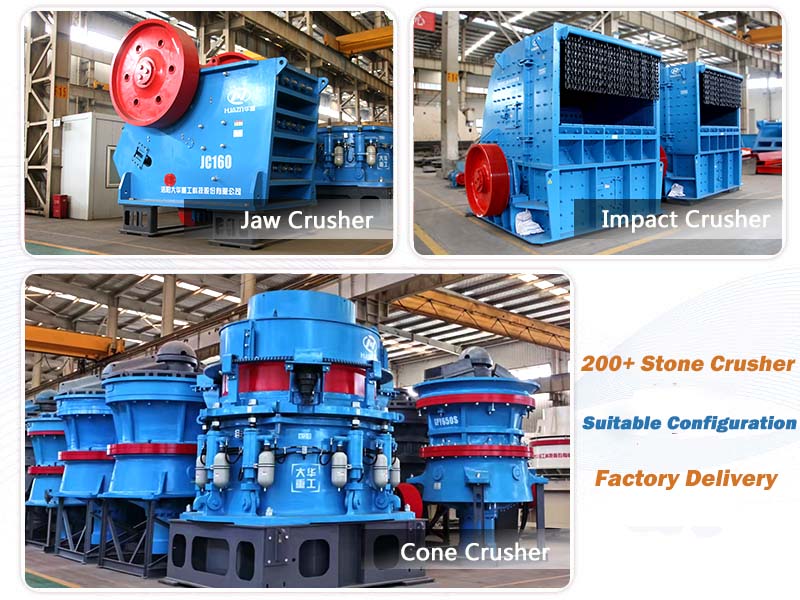
Crusher Selection Plan (Based on Material Hardness)
High-Hardness Materials (granite, basalt, river pebbles)
Configuration: Jaw crusher (primary crushing) + Cone crusher (secondary and fine crushing) + Impact crusher (shaping / sand making, optional).
Reason: Cone crushers have strong wear resistance and low operating costs, making them suitable for rocks with high compressive strength. Impact crushers consume too many wear parts on such materials.
Medium-to-Low Hardness Materials (limestone, bluestone, shale)
Configuration: Jaw crusher (primary crushing) + Impact crusher (secondary and fine crushing) – or a heavy hammer crusher (one-stage forming).
Reason: Impact crushers produce a good particle shape (more cubical particles, fewer flaky and elongated ones), and their operating cost for medium-hard materials is lower than that of cone crushers. Hammer crushers are suitable for small-scale production lines that aim for a simplified process.
Special Condition (space-constrained sites, construction waste recycling)
Configuration: Track-mounted or tyre-mounted mobile crushing plants (which can flexibly combine the above main crushers).
Reason: They require no foundation piles and can be driven directly to the job site, making them ideal for scattered operations along highway routes.

Key Selection Recommendations
Primary crushing stage: Regardless of the material, a jaw crusher is the first choice for processing large blocks of raw stone.
Particle shape requirements: High-grade highway asphalt surfaces demand very high aggregate shape quality. Therefore, an impact crusher or vertical shaft impact crusher must be added in the secondary/fine crushing stage for shaping, in order to reduce the content of flaky and elongated particles.
Process combination: A standard production line typically follows: feeder → jaw crusher → screening → cone/impact crusher → re-screening → finished products. A closed-circuit loop ensures precise gradation control.
Luoyang Dahua Heavy Industry is a high-tech enterprise with research & development production, sales, and service. Our company not only guarantees the products quality, but also provides perfect after-sales service. Luoyang Dahua has a professional R & D team, a strong after-sales team, from the equipment selection, site inspection, equipment manufacturing, installation, commissioning, delivery and other aspects for your service. If you have any questions, please contact the Online Service or Whatsapp +86 13938852499 at any time.
