
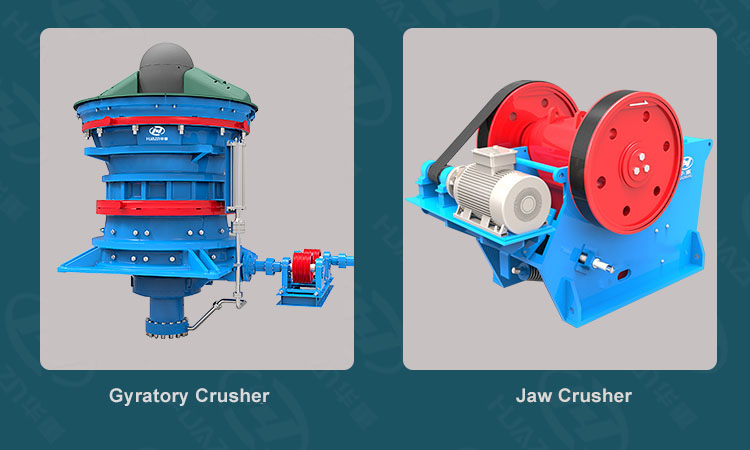
When setting up a stone crushing production line, one of the most critical decisions is selecting the right equipment for primary (coarse) crushing. Both jaw crushers and gyratory crushers are commonly used in this stage, but each has distinct advantages and limitations. To help you make an informed choice, here is an original comparison based on key performance factors.

1. Processing Capacity
Jaw Crusher: Operates with an intermittent crushing action, resulting in relatively lower efficiency. Its single-machine output typically ranges from 7 to 2,000 tons per hour. However, it handles moist materials well without clogging.
Gyratory Crusher: Offers continuous crushing, leading to high efficiency and a large crushing ratio. Output can reach up to 8,880 tons per hour. It runs smoothly, accepts feed from any direction, and allows choke feeding (full chamber).
2. Structure and Footprint
Jaw Crusher: Features a simple, low-cost design with a low machine height, making it easy to install and maintain. It requires less investment in civil works.
Gyratory Crusher: Has a complex, tall, and heavy structure, demanding a higher building and larger foundation. Transport and relocation are more challenging.
3. Feed and Discharge Particle Sizes
Jaw Crusher: Requires strict feed size control – material must stay within a specific range. The product tends to be flaky, sharp, or triangular (needle-like particles can exceed 20%), so shape quality is lower.
Gyratory Crusher: Accepts larger feed sizes and produces a finer, more uniform discharge. Needle-like particles are generally below 10%. Raw material can be dumped directly from trucks into the feed opening, often eliminating the need for a feeder.

4. Wear Part Life
Jaw Crusher: Relies on compression between a movable and a fixed jaw plate. Direct contact with material is extensive, leading to faster wear and more frequent maintenance.
Gyratory Crusher: Uses inter-particle (layer) compression inside a circular crushing chamber. This principle reduces direct wear on liners, resulting in longer service life for wear parts.
5. Energy Consumption
Jaw Crusher: Non-continuous crushing, lower unit output, and a higher proportion of coarse, unevenly sized particles increase its energy consumption per ton.
Gyratory Crusher: Medium-sized gyratory crushers generally consume much less energy on average compared to large or medium-sized jaw crushers.
6. Maintenance and Operating Costs
Jaw Crusher: Daily operation and maintenance are simpler and less expensive in terms of labor and repair complexity.
Gyratory Crusher: Higher initial purchase price, but lower long-term operating costs and longer intervals between major overhauls.
7. Suitable Materials and Applications
Jaw Crusher: Handles sticky, high moisture ores well without blocking. It is often the preferred coarse crusher for small to medium sized concentrators and quarries.
Gyratory Crusher: Ideal for primary crushing of hard materials of various hardness levels, but not suitable for sticky ores. It is widely used in large scale mining and processing plants.

Jaw crusher or gyratory crusher for stone coarse crushing?
The right choice depends entirely on your project’s specific needs and conditions. Before deciding, carefully evaluate rock type and moisture content, required throughput capacity, budget constraints (initial vs. long-term costs), and available space and infrastructure.
Luoyang Dahua Heavy Industry is a high-tech enterprise with research & development production, sales, and service. Our company not only guarantees the products quality, but also provides perfect after-sales service. Luoyang Dahua has a professional R & D team, a strong after-sales team, from the equipment selection, site inspection, equipment manufacturing, installation, commissioning, delivery and other aspects for your service.